Local leak guide
What actually goes wrong with pipes in North Sydney
Party walls carry water sideways
Shared masonry does not respect the boundary on the title. Water entering a party wall is physically inside two houses at once, and it will damage both.
So a leak in a terrace is immediately the neighbour's problem too, whether or not either party wants it to be.
That is the fact everything else on this page follows from, and it is why the conversation next door happens early rather than late.
Lead-jointed cast iron and early copper
Housing from the 1860s onwards has original cast iron and, later, early copper, and both fail quietly rather than dramatically.
Cast iron corrodes from the inside and eventually perforates. Copper thins and weeps at a point rather than splitting.
Neither announces itself, which is why the meter test matters more on this housing than on anything modern.
Elevation changes pressure over a short distance
These streets climb hard from the water. Mains pressure falls as you go up and rises as you come down, so two houses in one street can see very different static pressure.
High pressure is hard on everything with a seal in it: taps, cistern valves, appliance inlets and every flexible hose in the building.
It is measurable with a gauge in two minutes, and on a low-set property it is the first thing worth checking when several small things fail early.
On a slope, the wet patch is not the leak
Water escaping under pressure underground follows the ground down and surfaces wherever it finally can, which on these streets can be well below where it left the pipe.
Indoors it does the same thing through the structure, appearing on a lower level with nothing visible in between.
So the visible mark is an exit rather than an address, and digging under it is the expensive guess.
The meter is the honest test
Shut every tap and appliance and watch the meter for a quarter of an hour. Movement with nothing running means water is genuinely leaving on your side.
In a terrace the meters are frequently side by side at the front, so check which one is yours before drawing conclusions.
A still meter with visible damp means the damp has another cause, which in this housing is common.
The follow-up test, once a loss is confirmed
Shut the valve on the inlet to the hot water unit and take a second meter reading. It costs nothing and it removes half the property from consideration.
A dial that keeps moving is telling you the cold side. A dial that stops is telling you the unit or the hot line it feeds.
Have a look at the relief valve discharge point too. A steady dribble there reads as a leak and is an inexpensive fix rather than a search.
Talk to the neighbour before anybody opens a wall
Access to test both sides is the practical reason. The meter test needs both properties, and so does thermal imaging on a shared structure.
It is also a much easier conversation at the point of finding out than after one side has committed to a repair.
Opening a party wall is disruptive, structural and possibly for somebody else's fault, which is why it comes last rather than first.
Locate before you open
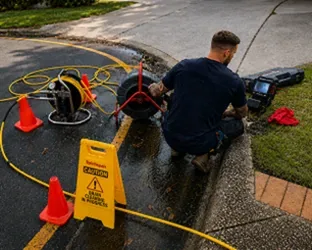
Acoustic listening, pressure testing and thermal imaging narrow a leak without disturbing the building, and masonry carries the sound of a pressurised leak well.
In a house with original plaster and joinery, what gets damaged by an exploratory opening is not replaceable from a warehouse.
The cost of locating properly is a fraction of the cost of opening the wrong wall once.
Get the finding in writing
Especially where the conversation is going to be with a neighbour. A written account of what was tested, what was found and where is a fact both parties can look at.
A verbal opinion relayed across a fence is not, and it is how reasonable people end up disagreeing about something that was measured.
We will write one. What we will not do is say who should pay for what.
Flexi hoses are still the fastest failure
For all the century-old pipework, the thing most likely to flood a house here is a braided hose past its service life, and five years is the usual figure.
They fail all at once, at mains pressure, in a cupboard nobody opens, and in a terrace on several levels the water goes through everything below.
They are cheap and quick to replace, and they are the one item here worth doing before anything is wrong.
Find your stop tap before you need it
Meters here are frequently in the front wall or a tiny front garden, and sometimes shared with next door.
Find it on a dry afternoon, check the tap turns, and note which one is yours if they sit together.
Learn the isolating valves indoors too, because closing one handles a specific failure without taking water off the house.
Documentation, and what it is actually for
Sydney Water operates an allowance that can reduce a bill inflated by a leak the customer could not reasonably have known about. The eligibility rules are theirs and worth reading in their own material.
An application is supported by evidence rather than by an account: the date the loss was identified, what was found, and the repair by a licensed person.
None of that can be assembled after the fact, which is why the written finding is produced at the time and handed over.