Local drain guide
What actually blocks drains in North Sydney
No side access changes the whole job
A terrace is sealed on both sides. The only route to the rear is through the house, and that decides what equipment can reach a line and what it costs to get there.
So the practical question here is not what is wrong with the drain. It is how anybody reaches it, and that is worth establishing on the phone.
It also means anything carried through has to be carried back out, which is a real consideration on a job that produces mess.
Fixtures that sit below the sewer
On the steep harbour-side blocks, a converted basement, a garage turned into a room or a lower-level bathroom can sit below the level of the sewer it has to reach.
Those need a pump rather than gravity, and a pumped fixture fails completely and without warning rather than slowing gradually.
If you have one, that is worth mentioning when you ring, because it changes the diagnosis entirely.
Stormwater on a slope goes somewhere
Flat suburbs get ponding. Here the water has momentum, so a blocked pit or an overshooting gutter sends water into the building or onto the neighbour below rather than into a puddle.
That makes stormwater maintenance more consequential on these streets than it is on level ground.
Pits and downpipes are worth clearing on a schedule rather than on appearance, before the wet months rather than during them.
Cast iron, and the bore you cannot see
The terraces still run a great deal of original cast iron. It corrodes from the inside and loses bore steadily over decades with nothing visible from outside.
So the line is not only accumulating material, it has less room for it than it started with, and both effects compound.
That is why a building can go from occasional trouble to regular trouble without anything having obviously changed.
Shared lines between terraces
Terraces frequently share drainage, or run a line along or under a neighbour's property, and almost nobody knows which arrangement they have.
So a blockage can be caused upstream by a household with no symptom at all, and a repair may sit under somebody else's courtyard.
A camera survey settles it, and on a shared line it is worth doing before any conversation with a neighbour starts.
Which fixtures, and how often
A single slow basin is that fixture and its trap. Several, or the lowest fixture in the house, is the main line out telling you so.
Once is an event. Three times in a year at the same point is a defect describing itself, and on a shared line the occurrences may move between houses.
Keep a rough note of the dates, and ask the neighbours. Both are genuinely useful here.
Rain or no rain splits the diagnosis
A sewer blockage is indifferent to the weather. Trouble that only arrives in a downpour and eases when it stops is the stormwater side.
On a steep block that distinction matters more, because stormwater moving fast does damage that stormwater sitting still does not.
Saying which one you have gets the right equipment to a street where parking is its own problem.
Roots find a joint that has already moved
Roots do not break sound pipe. They enter at an opening the ground has given them, and jointed lines of this age offer one every metre.
Front gardens on these terraces are small and the street trees are mature, so a tree is frequently very close to the line.
The durable repair removes the opening rather than this season's growth, and it does not ask anybody to take a street tree out.
Wipes and kitchen fat, on a narrowed line
Wipes remain the largest single cause of what we cut out of drains, and on cast iron that has already lost bore there is less room to give up.
Kitchen fat is the slower version, and on a shared line it arrives from more than one kitchen.
So both of the ordinary causes have more effect here than they would in a modern house on its own line.
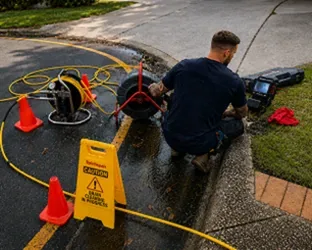
What the footage settles
Whether the line is restricted by material, by corrosion or by a defect, where it runs, and whether anybody else is on it. All four are genuine questions here.
The recording is yours whatever it shows, and on a shared line it is worth sharing with whoever else is connected.
It is also the only way to establish a route that has never been documented anywhere.